
Stablecoin payment rails are evolving fast, and so are the people trying to exploit them.
You've probably seen the posts where someone sends funds to the wrong wallet address. Increasingly it's deliberate: clipboard malware that swaps a copied address for an attacker's before you paste, keeping the first and last few characters to stay disguised, and address poisoning that plants lookalike addresses in your transaction history.
All of it points to one uncomfortable truth. Speed is the whole promise of stablecoin payments, and speed removes the safety net. Once funds settle, they're gone. No dispute window, no reversal, no one to call.
For retail users that's painful. For institutions and businesses moving millions, it's unacceptable. You can't build serious payment infrastructure on a rail where a single mistaken or fraudulent transaction is final.
The fix is a programmable trust layer sitting between “send” and “settled.”
The idea is simple: give instant stablecoin payments the one thing wire transfers always had, a moment to catch a mistake. Through programmable escrow you can add time-based locks for a defined window, multi-signature approval on high-value transfers, and the ability to halt or reverse a transaction if fraud is detected, all without giving up your choice of custody or stablecoin partner.
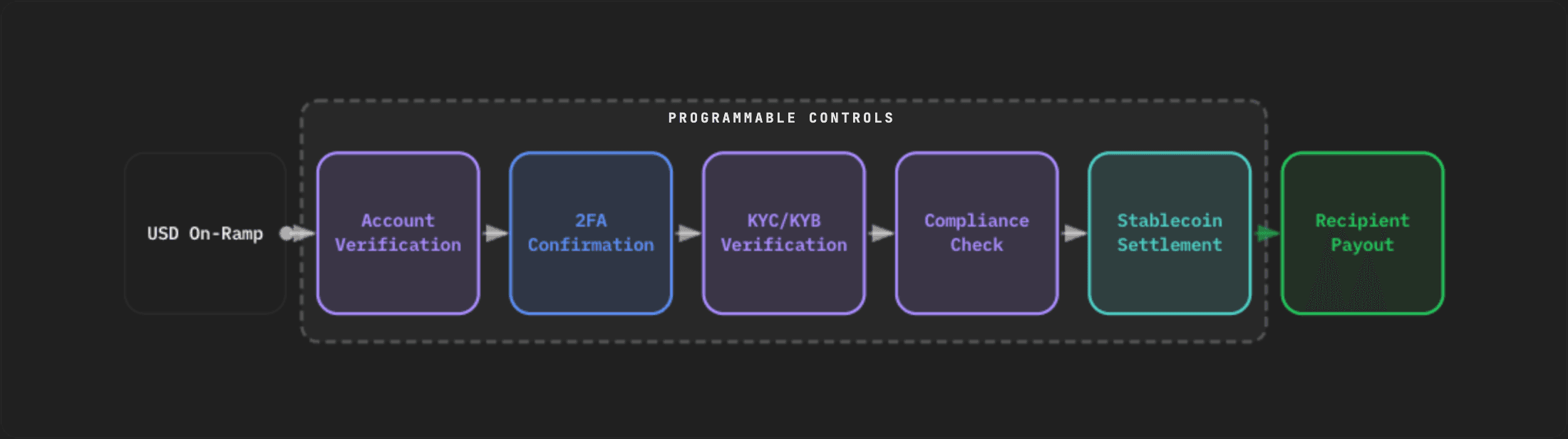
The payoff runs both ways. Institutions cut the operational cost of wires, reconciliation, and manual review, and can build new fee-based services on top of programmable controls. Users get a few minutes of protection that can be the difference between catching a scam and losing everything.
Take a concrete case. A digital banking app notices a wave of authorized push payment (APP) fraud, where scammers trick people into willingly sending money to a fraudulent account through impersonation, fake invoices, or investment scams. With a programmable layer, the app can place a short delay, say five minutes, on large outgoing payments. In that window the customer can confirm the transaction or cancel it the moment they realize something is wrong. Infrastructure like Coinbax is one example of this being built today, but the principle matters more than any single provider.

That short wait is the entire point:
- Institutions and businesses gain a review window to catch and revoke fraud before settlement, instead of the few irreversible seconds a raw wallet transfer gives them.
- Fintech users get timely intervention when fraud happens, which lowers losses and raises trust, and trust is what keeps customers.
This is what I mean by the trust layer for stablecoin payments. The rails are fast enough. The networks are liquid enough. What the next phase of adoption needs, especially for the institutions still on the sidelines, is a way to move at stablecoin speed without inheriting stablecoin finality risk.
Speed got stablecoins this far. Trust is what takes them mainstream.